Story, Fact, and Interpretation
Life of PiStory, Fact, and Interpretation is the novel’s closing problem: whether a life can be rendered as neutral fact, or whether telling and understanding inevitably make a story. Through Pi Patel’s exchange with Tomohiro Okamoto and Atsuro Chiba, the question becomes practical as well as philosophical. The investigators want an account of the Tsimtsum’s sinking without animals; Pi asks what kind of truth such a demand can secure when no one can prove which of his two accounts is true. Their eventual preference for the animal story does not settle the facts. It reveals how people choose between explanations when proof cannot decide for them.
The Demand for Straight Facts
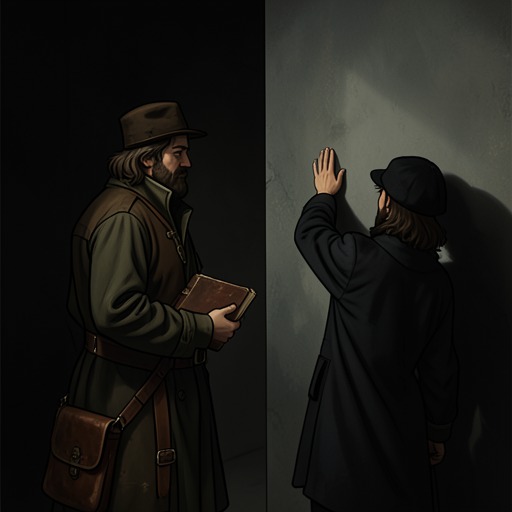
The dispute begins with a mismatch in expectations. The investigators want to know what really happened and ask for “the 'straight facts',” distinguishing a story, in their understanding, from an invention. Pi does not simply refuse their request. He examines its premise: “Doesn't the telling of something-using words, English or Japanese-already something of an invention?” His challenge extends beyond language to perception itself. “Isn't just looking upon this world already something of an invention?” The exchange makes the investigators’ desired boundary unstable: an account must be expressed and understood before it can function as evidence, and those acts already involve interpretation.
Pi sharpens the point by suggesting that reality is not merely received but understood. “The world isn't just the way it is. It is how we understand it, no?” His formulation does not say that events never happened or that all accounts are equally demonstrable. Instead, it asks whether an account can reflect reality without also organizing it. The investigators answer that they want words that reflect reality and do not contradict it. Pi responds that tigers do not contradict reality. The tiger is therefore not introduced as a refutation of fact, but as a test of what the investigators are willing to accept as factual possibility.
The Animal Story and Its Rejection
The request for a version without animals exposes the investigators’ preferred limits. Pi describes what they want as a story that will not surprise them, but will confirm what they already know: “a flat story. An immobile story.” He calls this preference “dry, yeastless factuality.” His language distinguishes bare factuality from an account capable of enlarging its audience’s understanding. In his view, the investigators are not merely asking for accuracy; they are also asking for a story whose terms will leave their existing assumptions undisturbed.
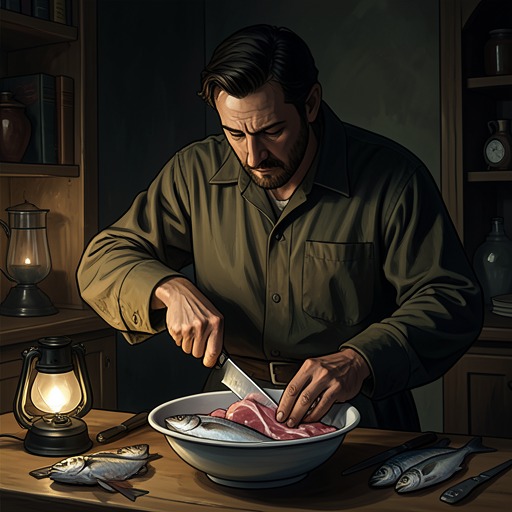
Their impatience is specific. They object to the tigers, and Pi names orang-utans, hyenas, and zebras as further elements they want excluded. The investigators confirm that they want “a story without animals” that will explain the sinking of the Tsimtsum. Pi pauses before offering another story. The pause matters: the alternative is not supplied as a quick correction to the first account, but as a response to the investigators’ stated demand. The exchange sets two tellings against each other while refusing to let the animal account be dismissed simply because its animals seem extraordinary to its listeners.
What the Two Accounts Share
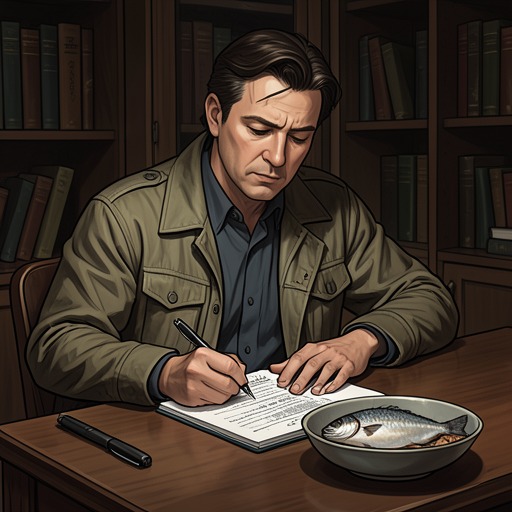
At the end, Pi identifies the common ground and the limits of comparison. He says that he has told two stories to account for the 227 days between the shipwreck and his arrival on the coast of Mexico on February 14, 1978. Neither account explains why the Tsimtsum sank, and neither makes a factual difference to the investigators. They cannot prove which story is true; Pi says they must take his word for it. The interview therefore does not produce the missing explanation for the sinking, nor a test that can conclusively adjudicate between the tellings.
The stories nevertheless share consequences central to Pi’s account: in both, the ship sinks, his entire family dies, and he suffers. That equivalence is not a claim that every detail is identical. It marks the facts that remain constant across the incompatible forms of narration and makes clear what is at stake in choosing between them. When Pi asks which story the investigators prefer, he explicitly frames the decision around the absence of a provable factual difference. Their answer cannot function as evidence establishing what happened; it discloses which version they find preferable under conditions of uncertainty.
Preference, Belief, and the Ending
Atsuro Chiba chooses the story with animals, and Tomohiro Okamoto agrees that it is the better story. The decision resolves the interview’s immediate question without resolving the underlying factual one. The investigators have been asked for a preference, not a verdict, and their answer accepts an account they cannot prove. Pi thanks them and adds, “And so it goes with God.” The final comparison connects the choice of story to belief: the investigators’ preference does not demonstrate that the animal story is factually true, just as the conversation has not supplied proof of God.
The response also changes the force of the interview. What began as an investigation into the Tsimtsum’s sinking ends with a question about how people make meaning when certainty is unavailable. The investigators have insisted on words that do not contradict reality, yet their final selection is guided by which account they prefer. Their choice does not erase the deaths, suffering, or unanswered cause of the shipwreck; it shows that factual equivalence alone cannot determine what a listener will accept as the better telling. Pi’s tears follow the exchange, while the investigators remain unsure what he means. The ending thus leaves interpretation active rather than closing it with proof: the story’s final significance rests in the choice the evidence cannot compel.